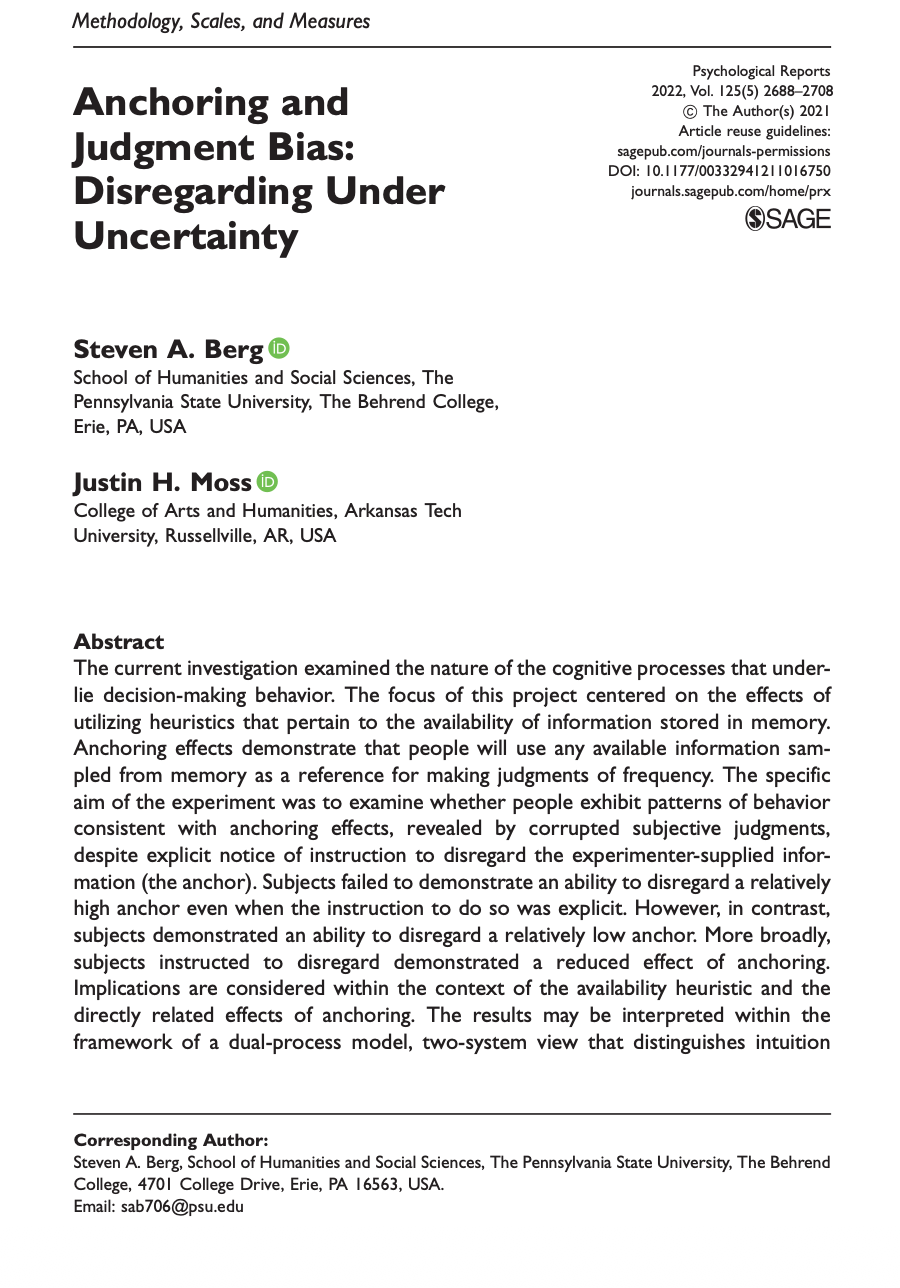
Anchoring and Judgment Bias:
Disregarding Under Uncertainty
Berg and Moss (2022)
GOAL: Examined cognitive processing consequences after exposure to extraneous information followed by explicit instruction to disregard it; aimed to more fully understand biases that factor into decision-making behavior
EXPERIMENTAL QUESTION: Will participants exhibit classic anchoring effects even when instructions tell them to ignore the biasing information?
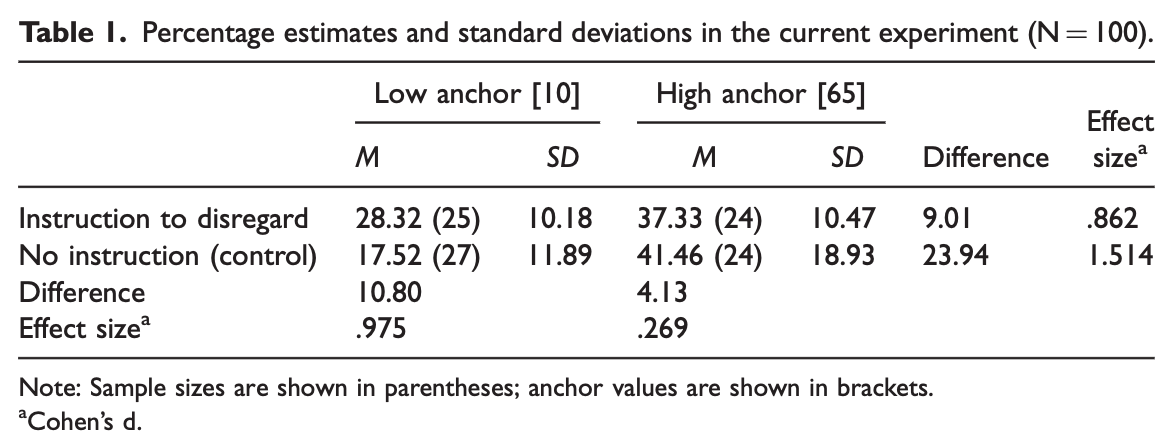
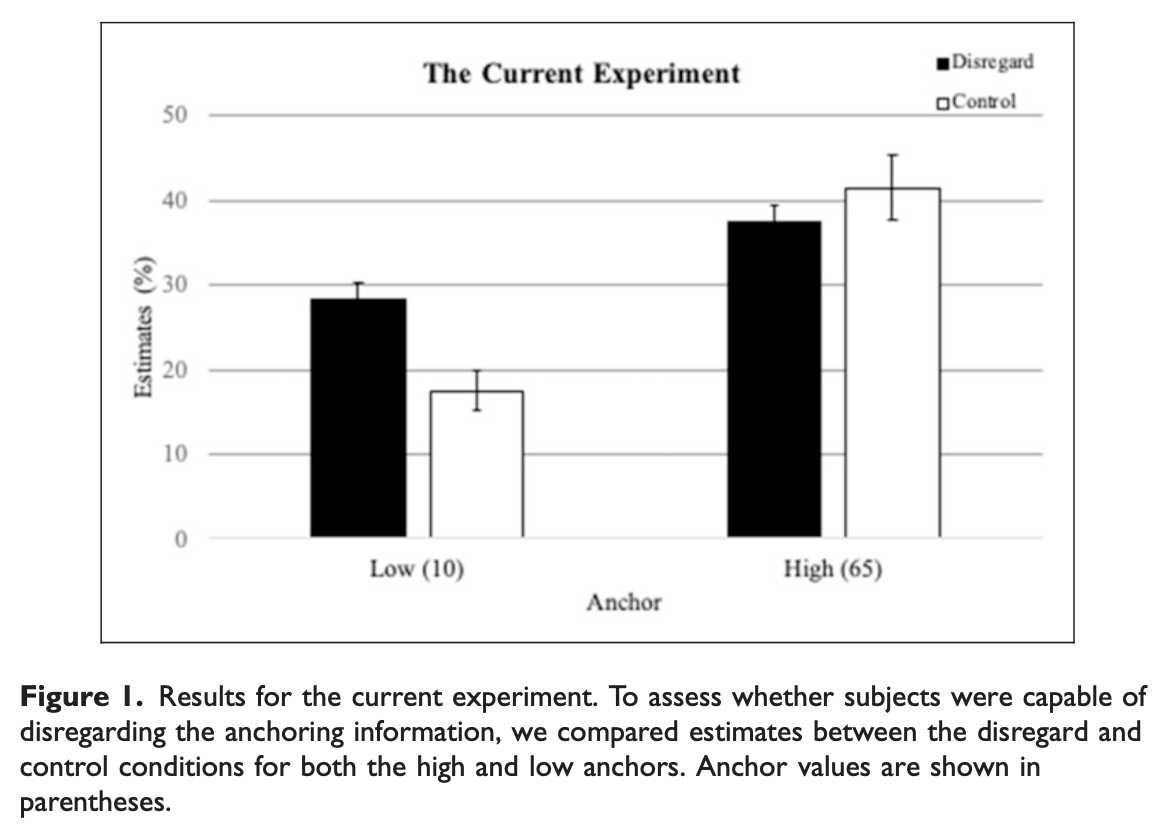
CONCLUSION: Even when instructions are explicit to ignore biasing information, observed effects on numerical estimates are evidence of failure to disregard
TAKEAWAY: Effects of anchoring and judgment bias have direct, concrete implications for UX design patterns (such as price anchoring in e-commerce, default pre-selections in onboarding flows, and form field priming); must be considered from earliest stages in design process
Insights
Support for the notion that participants, even when explicitly instructed to do so, do not disregard biasing anchors when making subsequent numerical estimates
High-magnitude anchors are resilient
Low-magnitude anchors are suppressible
Disregard instructions are asymmetrical
System 2 requires active engagement
Effects of anchoring and judgment bias have direct, concrete implications for UX design patterns:
Decision-making in high-stakes systems
Optimization of pricing strategies and e-commerce
Form defaults and survey design (on pricing tables, form placeholders, survey rating scales, error messages, and more)
Effects of anchoring and judgment bias have direct, concrete implications for UX research:
Leveraging "consider-the-opposite" strategies
The asymmetrical mitigation of "high-ceiling" bias
Ethical anchoring and the avoidance of deceptive patterns
For more on these insights, see my related case study (coming soon!)